
Insights Centre
L&D Predictions Report 2026: how AI is reshaping learning, leadership and readiness—moving from activity to capability and accountability.
AI is no longer an experiment in Learning & Development. It is already reshaping how work is done, how leaders decide, and how performance is measured.
The L&D Predictions Report 2026 reveals how organizations are moving from learning activity to enterprise capability, execution readiness, and accountability—and where many are still falling behind.
Why most organizations remain stuck between AI pilots and scale
How L&D is being evaluated on business outcomes, not participation
Why simulations and practice-based learning are overtaking content-first models
How leadership accountability (or the lack of it) is shaping AI adoption
Where measurement gaps are eroding L&D credibility
Why internal talent mobility remains a structural constraint on agility
How ethics, trust, and psychological safety are becoming operational risks
Organizations are investing more than ever in:
Yet confidence in readiness is not increasing at the same pace.
The L&D trends report shows a clear shift:
For leaders, the central question is no longer whether learning must change—but whether learning systems can evolve fast enough to support real performance in an AI-shaped world.
This L&D trends report is designed for:
If you are accountable for preparing people to perform, adapt, and lead, this report is essential reading.
How to move from fragmented learning initiatives to integrated capability systems
What “future readiness” really means when change is constant
Why leadership development must shift from insight to decision-making under pressure
How to move from fragmented learning initiatives to integrated capability systems
What “future readiness” really means when change is constant
L&D strategy and operating models | AI adoption and workforce readiness | Leadership development in AI-augmented organizations | Learning measurement and business impact | Skills intelligence and internal mobility | Culture, ethics, and psychological safety | Future readiness and organizational resilience
Get data-driven insights, leadership perspectives, and strategic implications shaping the future of learning and workforce capability.
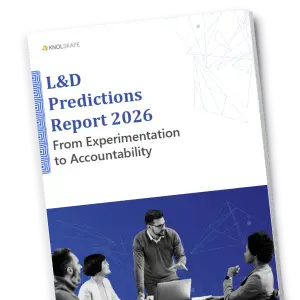
It explores how Learning & Development is evolving in response to AI adoption, leadership complexity, and the need for measurable business impact.
The report is published by KNOLSKAPE, a global leader in experiential learning, simulations, and AI-powered capability building.
Yes. The findings apply to business leaders, transformation teams, and executives responsible for performance, readiness, and AI adoption.
It focuses on execution readiness and accountability rather than surface-level trends, highlighting where organizations are structurally constrained.