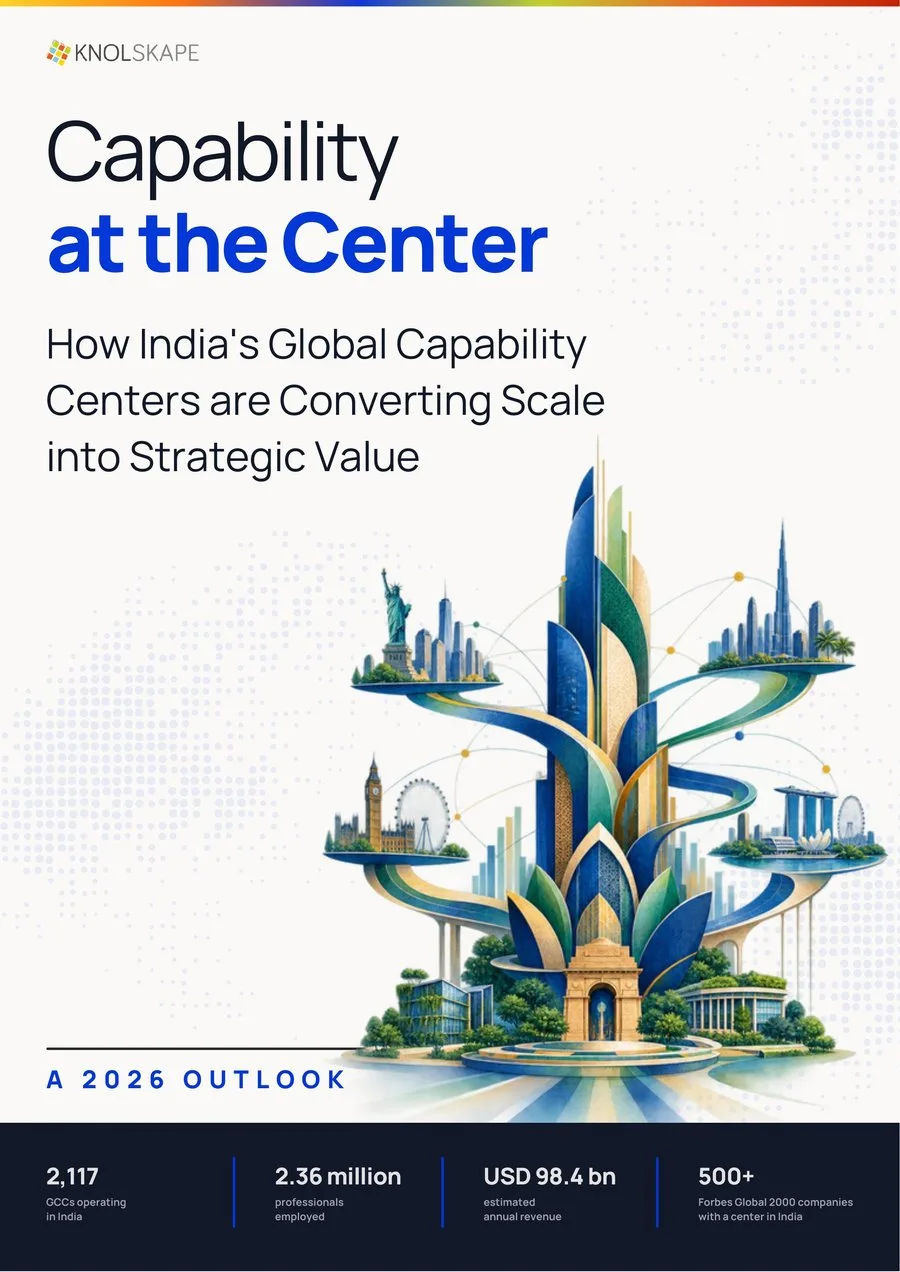
Capability at the Center: How India's Global Capability Centers are Converting Scale into Strategic Value | A 2026 Outlook
How India's 2,117 GCCs are converting scale into strategic value — and the AI and performance-readiness gaps standing between growth and genuine maturity.
Scale is no longer the constraint for India's GCCs — AI and performance readiness are.
India's Global Capability Center industry has crossed a genuine threshold. The country now hosts 2,117 GCCs operating across 3,728 units, employing close to 2.36 million professionals and generating an estimated USD 98.4 billion in annual revenue, according to the Nasscom-Zinnov GCC Value Orbit report for FY2026. More than 500 Forbes Global 2000 companies now run a center in India, and the ecosystem has grown 32 percent since FY2021 alone.
Beneath those headline numbers sits a familiar paradox. Ninety-six percent of GCCs established since FY2021 launched with an explicit product or portfolio mandate rather than a pure delivery brief, and Nasscom-Zinnov reports that nearly half the ecosystem now operates at a high maturity stage. Yet separate industry assessments circulating in the sector put the share of GCCs with genuinely advanced capability, meaning differentiated operating models, sustained innovation output, and measurable enterprise impact, closer to one in ten. Most centers have been handed the mandate to create value. Comparatively few have built the governance, culture, and measurement discipline required to actually deliver it at scale.
Two specific readiness gaps sit underneath that headline paradox, and both recur throughout this paper. The first is AI readiness: most GCCs are investing in generative and agentic AI, but comparatively few have built the governance, security, and decision rights needed to deploy it responsibly at enterprise scale. The second is performance readiness among GCC talent itself: hiring volumes have outpaced the structured, on-the-job capability building, deliberate practice, coaching, and contextual judgment, needed to make new talent genuinely deployable rather than merely credentialed. Closing the gap between growth and maturity depends on closing both.
India's GCC sector is not short on talent, capital, or ambition. What is uneven is the organizational maturity, the AI and governance readiness, and the performance readiness of people that together convert scale into the kind of value that shows up on a parent company's balance sheet rather than only on its cost sheet.
Key insights
2,117
GCCs operating in India
2.36 million
professionals employed across India's GCCs
USD 98.4 bn
estimated annual revenue generated by the sector
500+
Forbes Global 2000 companies with a center in India
Inside the report
Five dimensions of the readiness gap
Strong growth, uneven maturity
From labor arbitrage to capability arbitrage
AI readiness is a governance problem before it's a technology problem
Performance readiness behind the talent numbers
What value creation looks like in practice
Get the report
Access the Capability at the Center report
Get the full 2026 outlook on India's GCC sector — the five dimensions of the readiness gap, and the action agenda for closing it.