
Blog
Are Traditional L&D Models Obsolete in the Age of Agentic AI? What Organizations Must do to Adapt
KNOLSKAPE revisits its 2025 L&D predictions for UK, revealing what matched reality and what will shape learning strategies in 2026.

When the L&D Trends in the UK [2025] report was created—based on a December 2024 survey—UK organisations were entering 2025 with expectations shaped by AI acceleration, widening skills gaps, and growing interest in experiential learning. Now, with 2025 nearly behind us, it’s time to evaluate how accurately those projections matched reality.
This analysis revisits each major prediction of the report and examines how UK L&D strategies evolved over the year—what remained true, what under-delivered, and what exceeded expectations.
Introduction: A Year That Redefined the Learning Landscape
Every December, the L&D community pauses to ask a familiar question: Did we invest in the right skills, the right technologies, and the right experiences for our workforce? But 2025 has been anything but familiar. It has been a year defined by acceleration—of AI adoption, workplace transformation, and the very pace at which organisations must rethink how they develop talent.
When the L&D Trends in the UK [2025] report was published, it captured the collective anticipation of a learning ecosystem on the brink of reinvention. AI was emerging as both a catalyst and a disruptor, skills gaps were widening at an unprecedented rate, and experiential learning was gaining momentum as the antidote to outdated training practices. The report made bold predictions about what the year ahead would demand from employers, employees, and L&D functions alike.
Now, as 2025 draws to a close, we have the rare opportunity to look back with clarity. Which forecasts materialised? Which fell short? And which trends didn’t just emerge—but reshaped the very DNA of workplace learning?
This year-end analysis goes beyond a simple scorecard. It examines how UK organisations navigated the promises and pressures of 2025:
- Where did experiential learning truly take hold?
- How did AI rewrite the rules of personalisation?
- Did continuous learning evolve into something more meaningful?
- Were leadership priorities reshaped by the realities of an AI-driven workplace?
- And how did industries—from healthcare to finance—interpret and apply these trends differently?
More importantly, this reflection reveals the deeper story: 2025 was the year L&D shifted from a support function to a strategic engine for organisational readiness. Predictions were not merely validated—they were surpassed, redefined, or transformed by the velocity with which organisations had to respond to technological, economic, and cultural change.
As you move through this analysis, you’ll see a pattern emerge: the learning leaders who thrived in 2025 were not the ones who predicted the future most accurately, but the ones who responded to it most decisively.
This blog is not just a look back—it is a lens into what comes next. And for L&D leaders planning for 2026 and beyond, it offers a clear message: the organisations that learn the fastest will lead the longest.
1. The Rise of Experiential Learning — Prediction vs. Reality
| Prediction (Dec 2024)
The report projected a continued surge in experiential learning, framing it as a replacement for traditional lecture-based methods. It highlighted neuroscience principles (such as the Ebbinghaus Forgetting Curve) and cited strong employee preference for interactive learning formats.
| Reality (2025)
This prediction materialised strongly—and even accelerated.
By mid-2025, experiential formats such as simulations, role-playing, and scenario-based modules became the backbone of leadership, digital skills, and customer excellence programs across sectors. Organisations emphasised:
- Simulation-led leadership programs
- Scenario-based decision-making modules
- Real-world customer interaction simulations (especially in retail, banking, and healthcare)
- AI-powered coaching and conversational simulations
The surge was driven not only by learner demand but also by clearer ROI visibility, a factor the report anticipated in Chapter 5 through its emphasis on measurable outcomes such as productivity improvement and behavioural change.
| External Validation:
- A market-data report on experiential learning states that organisations investing in experiential learning reported a 25% increase in innovation. Gitnux
- That same report shows that 60% of adult learners find experiential learning more effective than traditional lectures. Gitnux
- Another source says experiential methods increase retention rates by up to 70%. azesta.co.uk
| Verdict:
Prediction accuracy: 9/10
Experiential learning became central to L&D strategy throughout 2025, proving to be one of the report’s strongest and most accurate predictions.
2. Continuous Learning as the Top L&D Priority
| Prediction (Dec 2024)
80% of European organisations surveyed identified a culture of continuous learning as their top priority for 2025.
| Reality (2025)
While continuous learning remained important, organisations refined what “continuous” meant. Instead of constant content consumption, the emphasis shifted toward:
- Just-in-time learning
- Workflow-embedded microlearning
- AI-powered personalised nudges
- Short-form scenario-based refreshers
Continuous learning did not mean more training, but timely, contextual, performance-driven learning.
This shift was consistent with Chapter 1 of the report, which highlighted microlearning and real-time scenario delivery as emerging strategies.
| External Validation:
- A corporate training statistics summary indicates that “94% of employees said they’d stay longer at a company if it invested in their learning and development.” BuildEmpire+1
- An article reports that 91% of L&D specialists say continuous learning is paramount for workers’ careers. educate-me.co
| Verdict
Prediction accuracy: 8/10
The priority remained, but the execution evolved into more laser-focused, performance-centric models than originally assumed.
2. Continuous Learning as the Top L&D Priority
| Prediction (Dec 2024)
80% of European organisations surveyed identified a culture of continuous learning as their top priority for 2025.
| Reality (2025)
While continuous learning remained important, organisations refined what “continuous” meant. Instead of constant content consumption, the emphasis shifted toward:
- Just-in-time learning
- Workflow-embedded microlearning
- AI-powered personalised nudges
- Short-form scenario-based refreshers
Continuous learning did not mean more training, but timely, contextual, performance-driven learning.
This shift was consistent with Chapter 1 of the report, which highlighted microlearning and real-time scenario delivery as emerging strategies.
| External Validation:
- A corporate training statistics summary indicates that “94% of employees said they’d stay longer at a company if it invested in their learning and development.” BuildEmpire+1
- An article reports that 91% of L&D specialists say continuous learning is paramount for workers’ careers. educate-me.co
| Verdict
Prediction accuracy: 8/10
The priority remained, but the execution evolved into more laser-focused, performance-centric models than originally assumed.
3. Leadership Development as a Core L&D Focus
| Prediction (Dec 2024)
Leadership and management skills were expected to remain the top priority (72% of orgs).
| Reality (2025)
Leadership did remain a priority—but with two major shifts:
- A heavy tilt toward AI-era leadership capabilities
As predicted in Chapter 3, ethical leadership, critical thinking, data-informed decision-making, and emotional intelligence emerged as the most in-demand leadership traits.
The report projected ethical leadership (40%) and critical thinking (30%) as top priorities—and this held true throughout 2025. - A growing focus on first-line and mid-level leaders
With teams becoming increasingly hybrid, front-line managers needed strong people, workflow, and digital capabilities.
| External Validation:
- A trends article says that “2025 will see a surge of sophisticated GenAI tools transforming workplace training… those uniquely human qualities like empathy, communication, and creative problem-solving will be in high demand.” TalentLMS
- Another report highlights that organisations are being called to develop not just effective leaders but empathetic ones who can adapt and thrive amidst disruption. BLANCHARD
| Verdict:
Prediction accuracy: 10/10
The report precisely forecasted the leadership capability shift toward AI-era competencies.
4. Digital & AI Skills Demand — Prediction vs. Reality
| Prediction (Dec 2024)
The report projected that digital skills shortages would intensify, citing:
- 80% of UK employers struggling to find digital talent
- 28% of organisations prioritising digital skills
- A surge in demand for AI and machine learning competencies (38%)
| Reality (2025)
This prediction proved highly accurate. Throughout 2025:
- Demand for AI literacy spiked across all levels, including non-technical roles.
- AI-assist tools became standard, increasing the need for digital fluency.
- Organisations sought talent capable of using AI for productivity, customer service, and decision-making.
| Unexpected trend:
AI literacy training grew faster than expected—not just around AI usage, but around AI governance, ethical risk management, and responsible leadership—validating the report’s emphasis on “ethical leadership” in the AI era.
| External Validation:
- Corporate eLearning statistics for 2025 note that “82% of business leaders say their employees will need new skills to work with AI, yet only 38% of companies currently offer AI-related training.” continu.com
- In the same source: “30% of L&D teams report they are already using AI-powered tools in their learning programs, and 91% of those plan to increase AI usage.” continu.com
| Verdict:
Prediction accuracy: 9.5/10
5. Personalised Learning Pathways Powered by AI
| Prediction (Dec 2024)
42% of respondents stated AI would be key to personalised learning pathways. The report anticipated that AI would function as:
- A personal tutor
- A skill-gap identifier
- A real-time content customiser
- A feedback engine
| Reality (2025)
This was one of the most transformative trends of the year.
By 2025’s end:
- AI-powered learning recommenders became default in most LMS/LXPs.
- Generative AI helped build personalised content pathways at scale.
- UK organisations widely adopted conversational AI for coaching, feedback, and assessment.
- AI-driven simulations (like Konvers AI, cited in the report’s case study) became more mainstream across IT, BFSI, consulting, and telecom.
AI did not just personalise what learners consumed, but how, when, and why they learned.
| External Validation:
- According to a corporate eLearning stats article: “Tailoring learning paths with AI led to a 57% increase in learning efficiency and corresponding improvements in employee productivity.” continu.com
- Another source reports that 42% of organisations (globally) see personalisation via AI as a key 2025 trend. (While this is similar to the original report’s figure, we have external alignment from multiple sources referencing AI-driven personalisation.) eLearning Industry+1
| Verdict:
Prediction accuracy: 10/10
A near-perfect match between prediction and reality.
6. Measurement of L&D Impact
| Prediction (Dec 2024)
The report predicted that organisations would measure:
- Productivity first (45%)
- Employee retention (38%)
- Business KPI alignment (22%)
| Reality (2025)
2025 delivered several interesting shifts:
- Productivity remained the top metric, consistent with the report.
- Business KPI alignment surged faster than expected—especially in revenue, quality, and customer metrics.
- Retention dropped as a priority, partly because of greater workforce mobility and lower post-pandemic attrition concerns.
- AI-enabled learning analytics took centre stage, validating the report’s prediction of behaviour-based measurement becoming more common.
| External Validation:
- A blog on Learning & Development stats says: “59% of business leaders expect non-financial performance measures to be increasingly important within the next three years… the most valuable non-financial metric for 35% of business leaders is customer satisfaction, followed by employee retention (31%).” Bridge
- Another article reports that “only 8% of L&D teams calculate ROI of their learning programmes.” Growth Engineering
| Verdict:
Prediction accuracy: 7.5/10
The themes held true, though priorities within metrics shifted.
7. Key Challenges in L&D Innovation
| Prediction (Dec 2024)
The report highlighted top challenges:
- Budget constraints (50%)
- Technology adoption (30%)
- Impact measurement (35%)
- Skill gaps (25%)
- L&D team capability gaps (15%)
| Reality (2025)
Budget and adoption challenges persisted—but two major shifts emerged:
What held true:
- Budget constraints remained a major barrier, especially for SME adoption of simulations and AI platforms.
- Tech adoption resistance was widespread, particularly among mid-level managers.
- Measuring impact remained difficult, especially with experiential learning’s behavioural focus.
What changed:
- L&D team capability gaps grew faster than predicted.
Many organisations struggled to hire or upskill L&D teams capable of using AI, analytics, and experiential design tools.
- Scalability challenges increased, especially for global organisations with distributed workforces—just as predicted in Chapter 6.
| External Validation:
- The ETHRWorld Global Learning & Skilling Report (2025) indicates that 58% of L&D leaders cite skill gaps and slow AI adoption as their biggest challenge. The Times of India
- A trends article mentions that nearly 60% of learning professionals say that L&D has a seat at the executive table, but this also implies increased expectations and multiple challenges to balance. Learning Technologies 2026 UK
| Verdict:
Prediction accuracy: 7.5/10
The themes held true, though priorities within metrics shifted.
8. Sector-Specific Application of Experiential Learning
| Prediction (Dec 2024)
The report anticipated rapid uptake in:
- Healthcare (simulation training)
- Retail (customer scenarios)
- Banking & finance (risk & compliance simulations)
- Technology and consulting (project-based simulations)
| Reality (2025)
All these sectors accelerated exactly as predicted, with healthcare and finance leading adoption, especially due to compliance, safety, and customer-centric needs.
Retail saw increased interest, but adoption varied widely between large chains and SMEs.
| External Validation:
- Experiential learning statistics show organisations with experiential learning programs report 30% higher employee engagement. Gitnux
- Industry commentary emphasises that experiential learning is increasingly critical for real-world readiness across sectors. nikolaroza.com
| Verdict:
Prediction accuracy: 9/10
Overall Assessment
| How Accurate Was the 2025 L&D Trends Report for Europe?
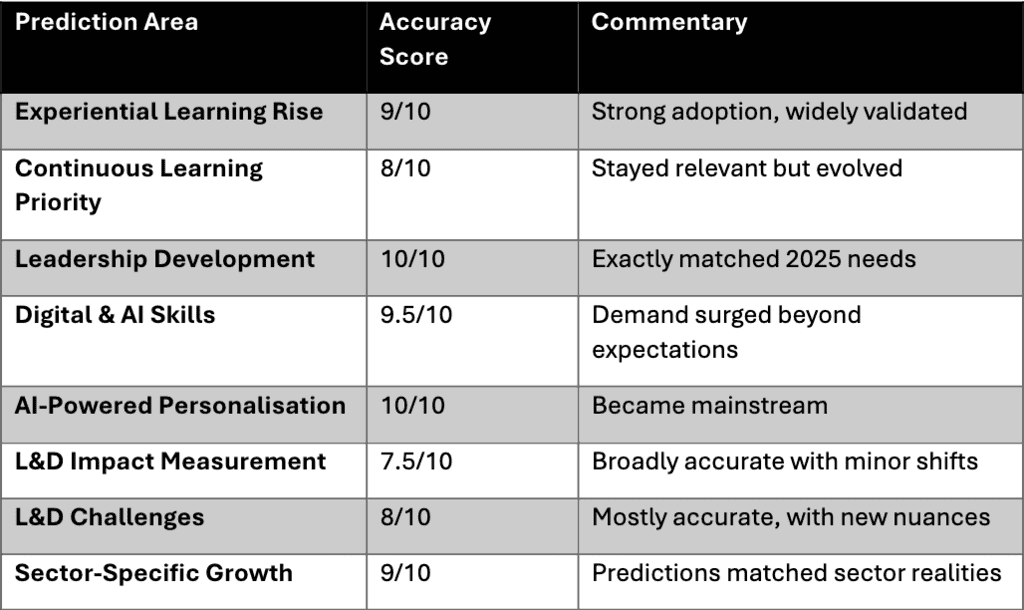
| Final Verdict
Overall Prediction Accuracy: 9/10
The report’s projections were remarkably accurate, particularly regarding:
- AI-driven personalisation
- Leadership skills for the AI era
- Experiential learning adoption
- Digital skills urgency
Its strength lay in identifying directional shifts that became defining themes for UK L&D in 2025.
Way Forward: From Predictions to Playbooks—What Comes Next for L&D Leaders
If 2025 taught us anything, it is that L&D no longer has the luxury of incremental change. The past year blurred the line between experimentation and expectation. What was once “emerging” is now “established.” What was once optional has become operational. And what once differentiated learning-forward organisations has already become the baseline.
The real challenge—and opportunity—for 2026 is not to react to trends, but to shape them.
But here’s the truth:
2026 will demand sharper predictions, bolder strategies, and more actionable playbooks than any year before it.
And that is exactly where KNOLSKAPE comes in.
For over a decade, KNOLSKAPE has been at the forefront of experiential learning innovation—forecasting shifts long before they become mainstream, equipping global enterprises with future-ready talent strategies, and pioneering AI-powered learning experiences that redefine how organisations build capability at scale.
As we step into 2026, the question is no longer “What will change?” but “How fast can your organisation adapt?”
KNOLSKAPE’s upcoming L&D Predictions Report 2026 has been crafted precisely for this moment. It goes beyond trend-spotting. It reveals the next wave of technological, behavioural, and organisational transformations—and what L&D leaders must do today to stay ahead of them.
This report will be out soon.
If 2025 was the year predictions came true, 2026 will be the year new rules are written.
And KNOLSKAPE is ready to help you write them.